
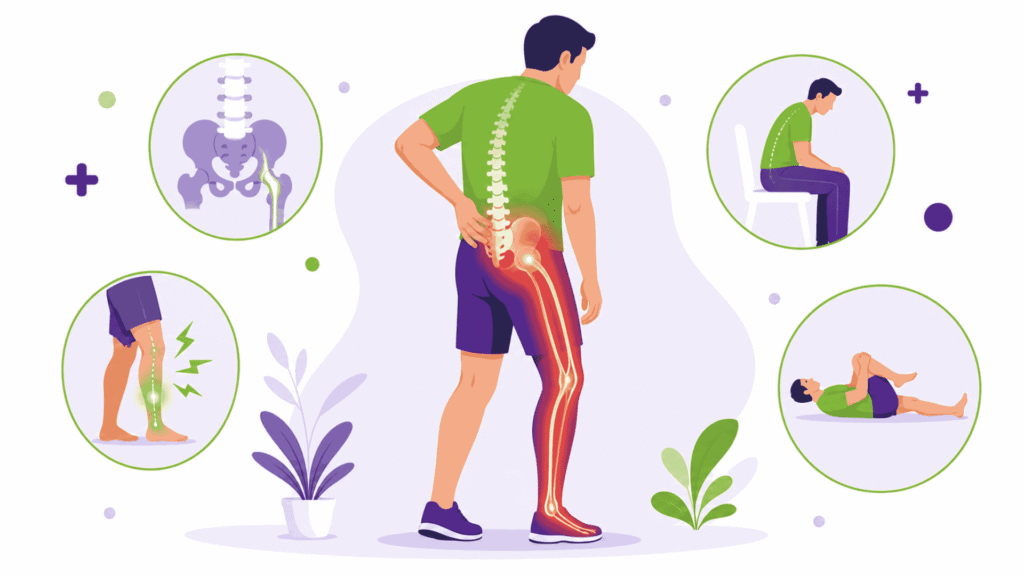
Have you ever felt a strange pain that starts in your lower back and seems to travel almost like a quiet ripple turning into a sharp wave down your hip and into your leg? Maybe it’s a tingling sensation, or a deep ache, or even a sudden electric-like jolt that catches you off guard when you move a certain way.
If that sounds familiar, you may be experiencing sciatica.
Now, here’s the thing about sciatica: it’s not just one type of pain, and it doesn’t feel the same for everyone. That’s what can make it confusing and sometimes a little worrying. At Goddard Chiropractic, we often meet people who say, “I know something isn’t right, but I can’t quite explain what it feels like.”
So let’s slow it down together and really understand what sciatica feels like in the lower back, hip, and leg and what your body might be trying to tell you.
First, What Is Sciatica Really?
Sciatica isn’t actually a condition on its own. It’s a term used to describe irritation or compression of the sciatic nerve, the longest nerve in your body. This nerve starts in your lower back, travels through your hips and glutes, and runs all the way down each leg.
When something puts pressure on that nerve—whether it’s a disc issue, joint misalignment, or muscle tension, you start to feel symptoms along its pathway.
And that’s why sciatica doesn’t stay in one place. It moves.
If you’d like a deeper look into the causes and treatments, you can read more about sciatica here and explore how it develops over time.
What Does Sciatica Feel Like in the Lower Back?
For many people, sciatica begins quietly in the lower back. It may not even feel alarming at first, just a mild discomfort or stiffness that comes and goes.
But over time, it can develop into something more noticeable.
You might feel:
- A dull, persistent ache in the lower back
- Tightness that makes it difficult to bend or twist
- Pain that worsens after sitting for long periods
- A deep, nagging discomfort that doesn’t fully go away
What’s interesting is that sometimes the lower back pain isn’t even the most intense part. In fact, many people say, “My back doesn’t hurt that much. It’s my leg that’s the problem.” And that’s a key clue pointing toward sciatica.
What Does Sciatica Feel Like in the Hip and Glutes?
As the sciatic nerve travels downward, the next place you’ll often feel it is in the hip or glute area. This is where the sensation can become more distinct and sometimes more frustrating.
People often describe it as:
- A deep, aching pain in one side of the hip
- A burning or warm sensation in the glute
- A feeling of pressure when sitting, especially on one side
- Discomfort that makes it hard to stay seated for long
You might even find yourself shifting your weight constantly, trying to “find a comfortable position,” but nothing quite works.
Because this pain sits so centrally in the body, it’s sometimes mistaken for general hip discomfort. If you’re unsure whether your symptoms are related to sciatica or something more localised, you can read more about hip pain here.
What Does Sciatica Feel Like in the Leg?
This is where sciatica often becomes unmistakable.
When the nerve irritation continues, the pain can travel down into the leg—sometimes all the way to the calf or foot. And this is where people tend to use more vivid language to describe what they’re feeling.
It may feel like:
- A sharp, shooting pain that travels down the leg
- Tingling or “pins and needles” sensations
- Numbness in certain areas of the leg or foot
- A sudden electric or shock-like feeling when moving
- Weakness, as if the leg doesn’t feel as strong or stable
One of the most telling signs of sciatica is that these symptoms typically affect only one side of the body.
And unlike muscle soreness, which tends to stay localised, nerve pain has a way of moving, following a path that can feel unpredictable and, at times, unsettling.
Why Does Sciatica Feel So Different?
Here’s something worth pausing on for a moment.
Sciatica feels different because it is different. It’s not just muscle pain or joint stiffness, it’s nerve related pain, and nerves communicate in their own unique language.
That’s why sciatica can feel like burning, tingling, numbness, or even electrical sensations. Your body isn’t just dealing with inflammation, it’s dealing with disrupted signals along a nerve pathway.
And when those signals aren’t flowing properly, your body responds in ways that can feel unusual, and sometimes even alarming.
What Can Make Sciatica Worse?
You may notice that certain movements or habits seem to aggravate your symptoms.
Common triggers include:
- Sitting for long periods, especially on hard surfaces
- Sudden movements like standing up quickly or twisting
- Bending forward or lifting incorrectly
- Lack of movement or prolonged inactivity
These patterns often increase pressure on the sciatic nerve, intensifying the symptoms.
How Chiropractic Care Can Help
Now, here’s the encouraging part.
Sciatica doesn’t have to be something you simply endure. In many cases, it responds very well to the right kind of care especially when the root cause is properly understood.
At Goddard Chiropractic, we take a step back and look at the body as a whole. Rather than focusing only on where the pain is felt, we look at why that pain is happening in the first place.
Often, sciatica is linked to:
- Spinal misalignments
- Disc irritation
- Imbalances in the hips or pelvis
Through gentle, targeted adjustments and personalised care, chiropractic treatment aims to relieve pressure on the sciatic nerve, restore proper alignment, and improve how your body moves overall.
Many people notice not only a reduction in pain, but also a sense of ease and freedom in their movement that they hadn’t realised they were missing.
If you’re curious about how this approach works, you can read more about chiropractic care here and see how it may support your recovery.
When Should You Seek Help?
Sciatica can sometimes come and go, but if your symptoms persist, worsen, or begin to interfere with your daily life, it’s important to seek professional guidance.
Pay attention if:
- The pain continues for more than a few days
- You experience increasing numbness or weakness
- The discomfort is affecting your ability to walk, sit, or sleep
Early care can make a meaningful difference, not just in relieving pain, but in preventing it from becoming a long-term issue.
Goddard Chiropractic| Best Chiropractor Reading
If there’s one thing to take away from all of this, it’s that your body is always communicating with you.
Sciatica isn’t random. It’s not something that just appears without reason. It’s a signal, a message that something along the pathway of movement and alignment needs attention.
And while that message may come in the form of discomfort, it also brings an opportunity: the chance to understand your body better, to support it more intentionally, and to move forward with greater ease.
At Goddard Chiropractic, we’re here to guide you through that process. Whether you’re just beginning to notice symptoms or have been dealing with sciatica for some time, support is available and relief is possible.
Because when your body moves the way it’s meant to, everything feels different.
FAQs
- Why does lower back pain spread to the hip and leg?
This usually happens when a nerve in the lower back becomes irritated, causing pain signals to travel along its pathway into the hip and leg instead of staying in one spot. - What are the most common symptoms of sciatica people notice first?
Most people first notice a dull lower back ache, followed by tingling, burning, or sharp pain that can move into the hip or one leg. - Why does sciatica pain feel worse when sitting for long hours?
Long sitting periods can increase pressure on the lower spine and surrounding nerves, which often makes discomfort in the back, hip, or leg more noticeable. - How can chiropractic care at our clinic help with sciatica?
At Goddard Chiropractic, we assess the root cause of nerve irritation and use gentle chiropractic adjustments, posture correction, and personalised care plans to help reduce pressure on the affected area and improve mobility and comfort. - When should I visit Goddard Chiropractic for sciatica treatment?
If symptoms are persistent, affecting your daily routine, or not improving with rest, visiting Goddard Chiropractic can help you get a proper assessment and a tailored treatment plan focused on long-term relief and improved movement.