Lower back pain doesn’t usually arrive as a dramatic injury.
More often, it creeps in quietly. A little stiffness in the morning. A dull ache after work. A sharp reminder when you bend, sit, or stand just a little too long. And before you realize it, your body starts negotiating every movement.
What makes lower back pain so frustrating is not just the discomfort, it’s the confusion around why it’s happening and what actually works. That’s why many people start exploring chiropractic care for lower back pain as a way to treat more than symptoms.
Here’s the key idea to understand from the start:
Lower back pain is rarely the problem. It’s the signal.
And chiropractic care is designed to interpret that signal not just silence it.
Lower Back Pain Is a Breakdown in How the Body Moves
Your lower back sits at a crossroads.
It connects your upper body to your hips. It absorbs force when you walk, run, lift, twist, and sit. And it works closely with your nervous system to keep movement efficient and controlled.
When movement breaks down somewhere in that system the hips, the spine, the core, the lower back often becomes the first place to feel it.
This is why chiropractic care focuses so heavily on how joints move, how muscles coordinate, and how the nervous system responds, rather than chasing pain alone.
Cause #1: Sitting Too Much and Moving Too Little
One of the most common drivers of lower back pain today isn’t injury.
It’s prolonged sitting.
Hours at a desk, in a car, or on the couch change how your body functions:
- Hip flexors tighten and pull on the lower spine
- Glutes weaken and stop stabilizing the pelvis
- Core muscles disengage
- Lumbar joints absorb more stress than they should
Over time, the lower back becomes overloaded. From a chiropractic perspective, this often shows up as restricted spinal joints, poor pelvic movement, and muscle imbalance. Chiropractic adjustments help restore motion to stiff joints, while corrective strategies help redistribute the workload back to the hips and core where it belongs.
Cause #2: Muscle Imbalances That Force the Back to Compensate
Lower back pain is rarely caused by a “weak back.”
It’s more often caused by a back that’s doing work it wasn’t designed to do alone.
When muscles like the glutes and deep core don’t activate properly, the lower back becomes the stabilizer of last resort. Over time, that compensation leads to fatigue, irritation, and pain.
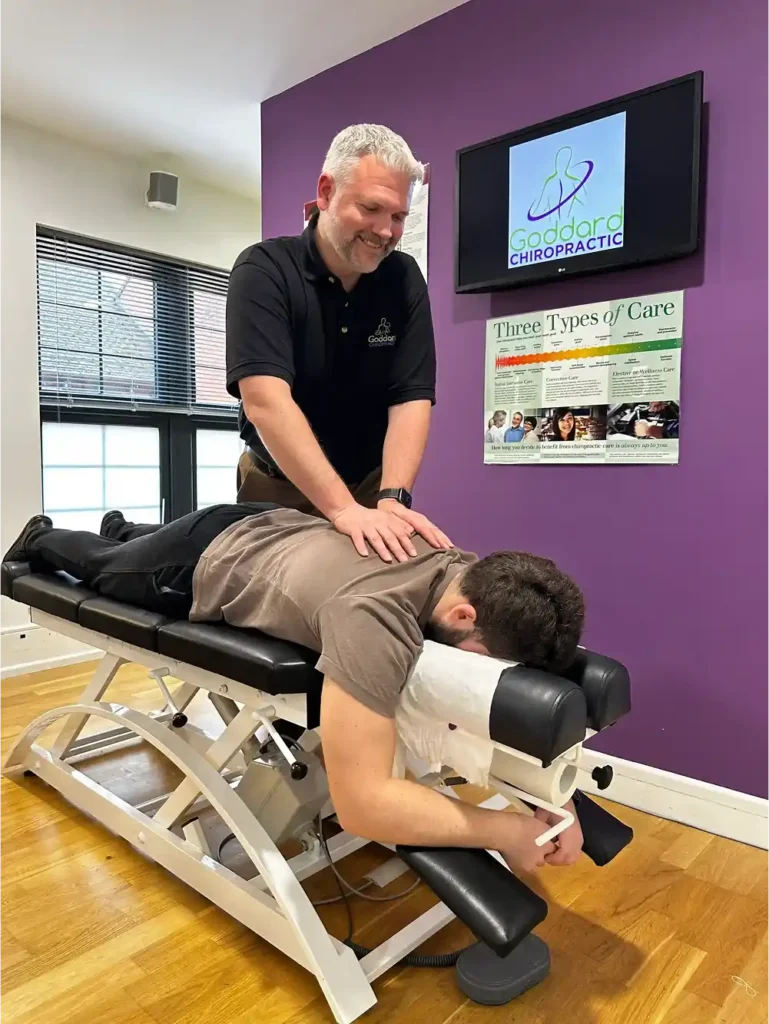
This is why chiropractic care doesn’t stop at adjustments. Restoring joint motion without addressing muscle support is like fixing a door hinge without checking the frame.
A comprehensive chiropractic approach looks at movement patterns, not just painful spots.
Cause #3: Restricted Spinal Motion and Joint Dysfunction
Here’s a powerful principle that connects lower back pain and chiropractic care:
Pain often develops where motion is lost.
When spinal joints become restricted from posture, stress, repetitive strain, or old injuries. The body compensates elsewhere. Muscles tighten to protect the area. Other joints move too much. The system becomes inefficient.
Chiropractic adjustments are designed to restore normal joint motion, which helps:
- Reduce abnormal stress on discs
- Calm muscle guarding
- Improve nervous system signaling
- Improve overall movement efficiency
When joints move better, the body often hurts less not because pain was “forced away,” but because function was restored.
Cause #4: Disc Irritation and Mechanical Stress
Discs act as shock absorbers between spinal bones. When they’re exposed to repeated compression, poor posture, or faulty movement patterns, they can become irritated or bulge.
This often leads to:
- Lower back pain that worsens with sitting
- Pain when bending forward
- Sharp or catching sensations
- Pain that travels into the hip or leg
Chiropractic care plays a role here by addressing mechanical stress , restoring joint motion, improving spinal alignment during movement, and reducing pressure on irritated tissues.
Many disc-related cases respond well to conservative chiropractic care when treated early and appropriately.
Cause #5: Sciatica Is a Nervous System Problem
Sciatica isn’t a diagnosis. It’s a symptom of nerve irritation.
That irritation can come from:
- Disc involvement
- Joint inflammation
- Muscle tension
- Poor spinal mechanics
From a chiropractic standpoint, sciatica highlights the importance of nervous system health. The spine doesn’t just move , it protects and communicates with nerves.
Chiropractic care aims to reduce mechanical interference along nerve pathways, helping restore proper signaling and reduce pain patterns that travel down the leg.
Cause #6: Stress, Tension, and the Overloaded Nervous System
One of the most overlooked connections in lower back pain is stress.
When stress is high:
- Muscles stay tense longer
- Breathing patterns change
- Recovery slows
- Pain sensitivity increases
The nervous system becomes more reactive and the lower back often pays the price.
Chiropractic care works with the nervous system, not against it. Restoring spinal motion can help regulate muscle tone and reduce protective tension, especially when combined with movement and recovery strategies.
So Can a Chiropractor “Fix” Lower Back Pain?
The better question is: Can chiropractic care address the reasons lower back pain exists?
In many cases, yes.
Especially when pain is driven by:
- Joint restriction
- Poor movement mechanics
- Muscle imbalance
- Disc irritation (non-surgical cases)
- Sciatic nerve involvement
Chiropractic care helps by improving how the body functions not just how it feels.
Relief is important. But lasting improvement comes from restoring balance between joints, muscles, and the nervous system. Read more about our chiropractic care services here.
What Chiropractic Care Looks Like When It’s Done Right
At Goddard Chiropractic, care for lower back pain is built around understanding the why.
That means:
- Identifying dysfunctional movement
- Restoring spinal and joint motion
- Supporting muscles and soft tissue
- Educating patients on posture and habits
- Building strategies to prevent recurrence
Because the goal isn’t dependency on care , it’s independence from pain.
When Lower Back Pain Needs Immediate Medical Attention
While most back pain is mechanical, seek immediate care if you experience:
- Loss of bladder or bowel control
- Progressive leg weakness
- Numbness in the groin or saddle area
- Fever with back pain
- Pain after major trauma
These symptoms require urgent medical evaluation. Learn more about our lower back pain treatment on this service page.
The Takeaway
Lower back pain is not a life sentence.
It’s a message.
And chiropractic care exists to help interpret that message by restoring motion, reducing stress on the spine, and helping your body move the way it was designed to move.
At Goddard Chiropractic, the focus isn’t just pain relief. It’s restoring confidence in your movement, rebuilding trust in your body, and helping you stay active for the long run.
Because when your body moves better, everything works better.