

It starts with something you barely notice.
Perhaps you wake up with a stiff neck and assume you’ve slept awkwardly. You turn your head, roll your shoulders and carry on with your morning. But by lunchtime, there’s an unfamiliar ache travelling towards your shoulder blade. Later, while answering emails, you notice a strange tingling sensation running down your arm.
You shake your hand, stretch your neck and hope it disappears.
But the feeling keeps coming back.
When pain begins travelling between your neck, shoulder and arm, it’s natural to wonder whether something more than ordinary muscle tension is happening.
One possibility is a pinched nerve.
At Goddard Chiropractic in Reading, we understand how unsettling unfamiliar symptoms can feel, especially when they begin interfering with everyday activities. Understanding the symptoms of a pinched nerve in the neck and shoulder can help you recognise when discomfort may be nerve-related and when it’s time to seek professional advice.
What Exactly Is a Pinched Nerve?
Your nerves act like an enormous communication network, carrying signals between your brain, spinal cord and the rest of your body.
The nerves leaving your neck travel towards your shoulders, arms and hands, helping control movement and sensation.
Sometimes, a nerve becomes irritated or compressed by surrounding structures. This may happen because of changes involving spinal discs, joints or nearby tissues.
When a nerve root in the neck becomes irritated, the condition is often called cervical radiculopathy.
And here’s where things become interesting.
Although the problem may begin in your neck, you might feel much of the discomfort somewhere else entirely.
A person with nerve irritation in the cervical spine may experience shoulder pain, arm symptoms or tingling in their fingers, even when their neck itself doesn’t feel particularly painful.
That’s why the location of your symptoms doesn’t always reveal where the problem began.
The Symptoms of a Pinched Nerve in the Neck and Shoulder
Imagine trying to work at your desk while an uncomfortable sensation keeps travelling from your neck into your shoulder.
You adjust your chair. You stretch. You change position. Sometimes it improves, only to return when you turn your head or reach for something.
The pinched nerve in neck or shoulder symptoms can vary depending on which nerve is affected and how irritated it has become.
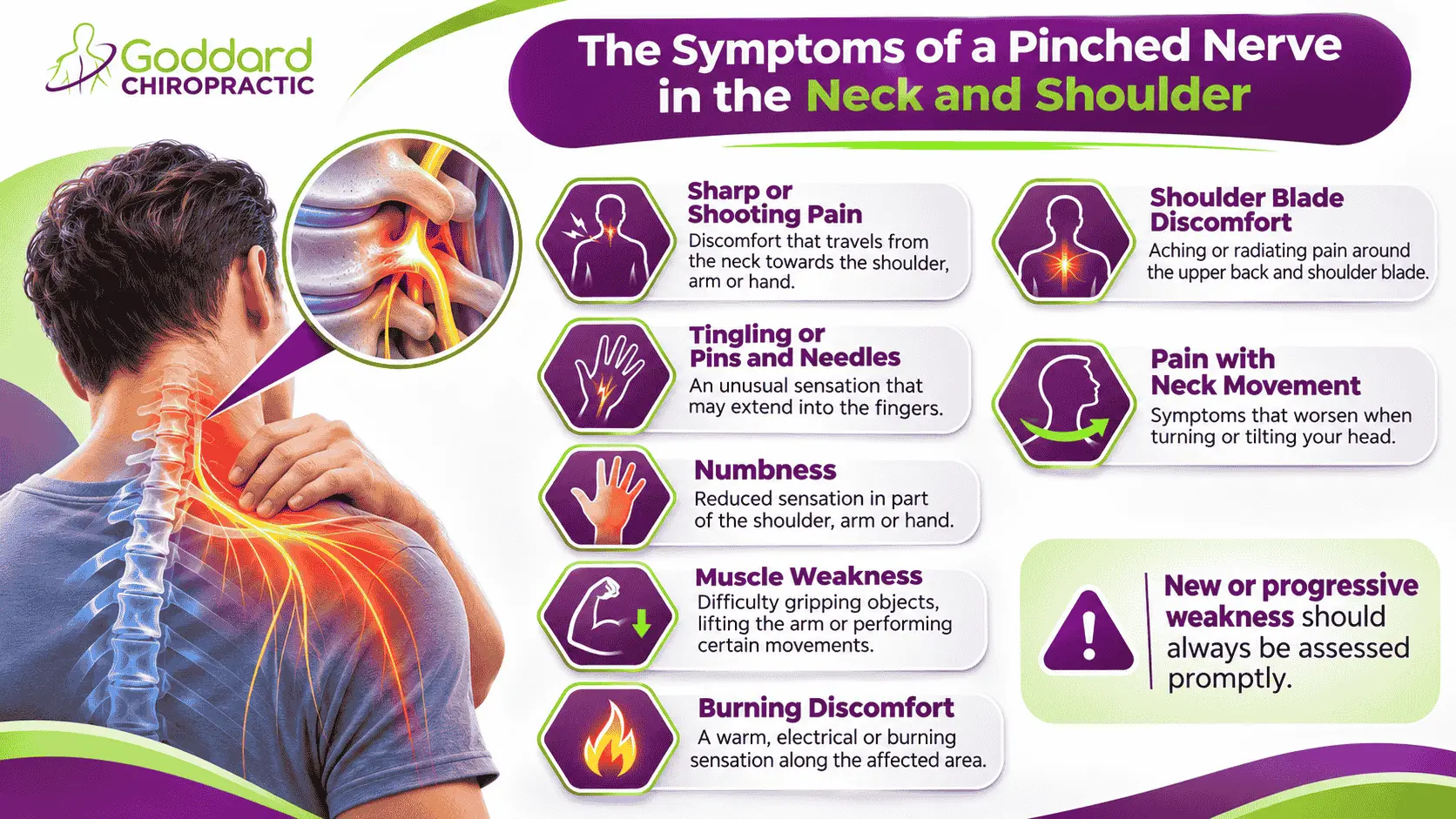
Common symptoms include:
- Sharp or shooting pain: Discomfort that travels from the neck towards the shoulder, arm or hand.
- Tingling or pins and needles: An unusual sensation that may extend into the fingers.
- Numbness: Reduced sensation in part of the shoulder, arm or hand.
- Muscle weakness: Difficulty gripping objects, lifting the arm or performing certain movements.
- Burning discomfort: A warm, electrical or burning sensation along the affected area.
- Pain with neck movement: Symptoms that worsen when turning or tilting your head.
- Shoulder blade discomfort: Aching or radiating pain around the upper back and shoulder blade.
Not everyone experiences all these symptoms. Some people notice mainly pain, while others experience tingling or weakness with relatively little discomfort.
New or progressive weakness should always be assessed promptly.
What Does a Trapped Nerve Feel Like?
One of the most common questions people ask is, what does a trapped nerve feel like?
The answer often comes down to the type of sensation.
Muscle discomfort usually feels like aching, tightness or tenderness. Nerve-related symptoms, however, may feel more like an electric shock, burning, tingling or pain travelling along a particular pathway.
For example, a person might notice discomfort beginning near the shoulder blade before spreading down the arm. Another may experience tingling in certain fingers whenever they turn their head.
But these sensations aren’t exclusive to nerve compression.
Muscle problems, shoulder conditions and other medical issues can sometimes create similar symptoms. That’s why it’s important not to diagnose a pinched nerve based on sensation alone.
Is It a Pinched Nerve in the Shoulder or the Neck?
Here’s something that surprises many people.
When someone says they have a pinched nerve in the shoulder, the nerve irritation may actually be originating in the neck.
The cervical spine contains nerve roots that supply different areas of the shoulder, arm and hand. When one becomes irritated, symptoms can travel along the nerve’s distribution.
However, nerves can also become compressed elsewhere, including around the shoulder or further down the arm.
A compressed nerve in the shoulder region may therefore produce symptoms that overlap with those of a cervical nerve problem.
The difference matters because treatment should address the actual source of the symptoms rather than simply the area where pain is felt.
Why Does a Trapped Nerve Hurt Around the Shoulder Blade?
Think about how closely your neck, shoulders and upper back work together.
Every time you reach overhead, turn your head or lift something, several muscles and joints coordinate the movement.
The neck and shoulder muscles provide support, while nerves carry the signals that make movement and sensation possible.
A trapped nerve in the shoulder blade is a phrase often used to describe pain around the shoulder blade, but the pain doesn’t necessarily mean a nerve is physically trapped there.
Sometimes, irritation of a nerve root in the neck produces referred pain around the shoulder blade. In other cases, muscular or joint-related problems may be responsible.
If the pain repeatedly returns or travels into your arm, a proper assessment can help identify what’s contributing.
What Causes a Pinched Nerve in the Neck?
There isn’t always one obvious event that causes nerve irritation.
Sometimes symptoms appear after an injury. Other times, they develop gradually as changes occur within the cervical spine.
Possible causes include:
- A bulging or herniated cervical disc
- Age-related changes in spinal joints
- Narrowing around the nerve openings
- Bone spurs associated with degenerative changes
- Certain injuries affecting the neck
- Compression of nerves elsewhere along their pathway
Long periods at a desk may aggravate existing symptoms, but poor posture alone shouldn’t automatically be blamed for nerve compression.
Understanding the underlying cause is important because not every case requires the same treatment.
Can Chiropractic Care Help a Pinched Nerve?
If you’ve been dealing with recurring neck and shoulder symptoms, it’s understandable to want something that provides more than temporary relief.
At Goddard Chiropractic, the first step is understanding what’s happening.
Your chiropractor may assess your neck movement, shoulder function, muscle strength, reflexes and sensation. Depending on your symptoms, further investigation or referral may be appropriate.
For some musculoskeletal conditions associated with neck pain, conservative management may include:
- Gentle joint mobilisation where appropriate
- Exercises to improve neck and upper-back movement
- Rehabilitation to support strength and function
- Advice on modifying aggravating activities
- Guidance on comfortable working and sleeping positions
Chiropractic care isn’t suitable for every cause of nerve compression, and spinal manipulation isn’t automatically appropriate when neurological symptoms are present.
If you’d like to learn more about the services available at our clinic, you can read more about our Chiropractic Care service here.
A Pinched Nerve in the Neck and Sciatica: What’s the Connection?
You may have heard someone describe shooting pain down their leg as sciatica.
Interestingly, the underlying principle can be similar.
Sciatica describes symptoms associated with irritation of the sciatic nerve or related nerve roots in the lower back. These symptoms may travel through the buttock and down the leg.
A pinched nerve in the neck, meanwhile, may cause pain, tingling or weakness travelling into the shoulder, arm or hand.
The locations are different, but both illustrate how nerve-related symptoms can appear some distance away from their source.
If you’ve experienced similar sensations in your lower body, you can read more about our Sciatica condition page here.
When Should You Seek Help?
It’s tempting to ignore tingling or shoulder discomfort when it comes and goes.
But persistent symptoms deserve attention, particularly when they’re affecting your ability to work, sleep or use your arm comfortably.
Arrange an assessment if you experience recurring pain travelling from your neck into your shoulder or arm, persistent tingling, numbness or difficulty with everyday movements.
Seek urgent medical attention if you develop sudden or rapidly worsening weakness, difficulty walking, loss of coordination, new bladder or bowel problems, or symptoms following a significant injury. Sudden arm symptoms accompanied by chest pain, breathing difficulty or stroke-like symptoms also require emergency care.
Your Body Is Trying to Tell You Something
One of the frustrating things about nerve-related discomfort is how unpredictable it can feel.
You might have a perfectly comfortable morning, only for pain to appear when you turn your head in the car. You may sleep well one night and wake up with tingling the next.
Over time, you begin thinking about movements that never used to require a second thought.
At Goddard Chiropractic in Reading, we believe understanding your symptoms is an important part of moving forward. If you’re searching for a shoulder pain chiropractor in Reading, our approach begins with listening to your concerns, assessing your symptoms and helping you understand the most appropriate next steps.
Because when your neck, shoulder or arm keeps sending you uncomfortable signals, the answer isn’t always to stretch harder or wait longer.
Sometimes it’s simply time to find out why.
FAQs
What does a pinched nerve feel like?
A pinched nerve may cause sharp, burning or shooting pain, tingling, numbness or weakness. Symptoms can travel along the affected nerve, which means a nerve irritated in the neck may produce discomfort in the shoulder, arm or hand.
How to release a pinched nerve in the shoulder blade?
There isn’t one exercise or technique that safely releases every pinched nerve. Treatment depends on whether the symptoms originate from the neck, shoulder or another structure. Gentle movement and avoiding aggravating positions may help some people, but persistent pain, tingling or weakness should be professionally assessed. Avoid forcefully manipulating your neck or shoulder yourself.
What can be mistaken for a pinched nerve?
Several conditions can produce similar symptoms, including rotator cuff problems, muscle strains, shoulder joint disorders, peripheral nerve entrapment and certain neurological conditions. A clinical assessment helps distinguish between these possibilities.
Can a pinched nerve in the neck cause shoulder pain?
Yes. Irritation of a cervical nerve root can cause pain that travels from the neck into the shoulder, shoulder blade, arm or hand. This is one reason shoulder pain sometimes requires an assessment of the neck as well.
How long does a pinched nerve in the neck take to heal?
Recovery varies depending on the cause and severity of nerve irritation. Many cases of cervical radiculopathy improve over several weeks with appropriate conservative management, while others take longer or require additional investigation. Progressive weakness or persistent neurological symptoms should not be ignored.
Can a pinched nerve cause tingling in the fingers?
Yes. Irritation of certain nerves in the neck can cause tingling or altered sensation in the fingers. However, similar symptoms may also arise from nerve compression at the elbow or wrist, so an assessment is important to identify the source.