You know that feeling when your shoulders have been tight for days, your legs are still complaining about last weekend’s run, or there’s a stubborn knot in your back that seems determined to stay?
You stretch a little, move around, perhaps even convince yourself that a good night’s sleep will sort everything out. But the next morning, that familiar tightness is still there.
It’s usually around this point that people begin thinking about booking a sports massage.
But here’s something you might not realise.
Not all sports massages are the same.
The treatment that helps a runner prepare for a race may be quite different from the one someone needs after a demanding training session. And the massage that feels wonderful when your muscles are tired might not be appropriate when you’re recovering from an injury.
At
Goddard Chiropractic in Reading
we believe understanding your body is just as important as looking after it. So, before you book your next appointment, let’s explore the four main types of sports massage, how they differ and which might be most appropriate for you.
If you’re curious about how hands-on treatment may help with muscular discomfort, you can
read more about our Sports Massage service.
First, What Makes a Sports Massage Different?
Imagine two people walking into a clinic on the same morning.
One is preparing for a half marathon this weekend. Their legs feel reasonably good, but they’d like some help managing the tightness that has developed during training.
The other has just completed a demanding sporting event and feels as though every muscle has something to say about it.
Both may benefit from sports massage, but giving them exactly the same treatment wouldn’t necessarily make sense.
Unlike a general relaxation massage, sports massage is usually tailored towards the physical demands placed on your muscles and other soft tissues. It may involve different pressures, techniques and areas of focus depending on your activity, symptoms and goals.
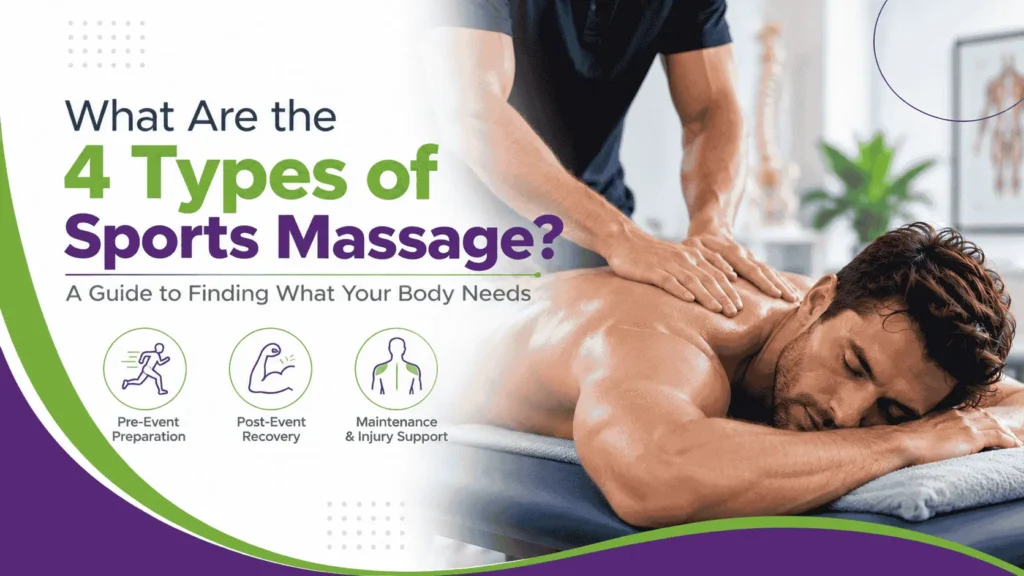
Although practitioners sometimes use different classifications, the four commonly described types of sports massage are pre-event, post-event, maintenance and rehabilitative massage.
Let’s look at what makes each one different.
1. Pre-Event Sports Massage: Getting Ready for the Starting Line
Picture the morning of a race.
You’ve trained for weeks, laid out your running clothes the night before and checked the weather more times than you’d like to admit. Your body feels ready, but there’s that familiar nervous energy as the start time approaches.
A pre-event sports massage is designed to complement your preparation rather than leave your muscles feeling heavily worked.
It generally uses lighter, quicker techniques and is performed relatively close to an activity when appropriate.
What Can Pre-Event Massage Help With?
Depending on your needs, it may help:
- Reduce the sensation of muscular tightness
- Encourage comfortable movement
- Support relaxation before an event
- Help you feel physically prepared
- Draw attention to areas of discomfort that need consideration
One important thing to remember is that a pre-event massage shouldn’t replace your warm-up. Nor is the morning of a competition the ideal time to experiment with an unfamiliar, intensive treatment.
The aim is to arrive at the starting line feeling comfortable, not wondering why your legs are suddenly sore.
2. Post-Event Sports Massage: When Your Muscles Have Done Their Job
There’s a particular satisfaction that comes after finishing something physically demanding.
Maybe you’ve completed your first 10K, returned from a long cycle or finally finished a challenging gym session. You’re proud of what you’ve achieved, but your muscles are beginning to remind you how much effort went into it.
Post-event sports massage focuses on comfort and recovery following physical activity.
Treatment is generally adapted to how your body feels, with lighter techniques often being more appropriate immediately after strenuous exercise.
What Are the Potential Benefits?
Post-event massage may:
- Reduce perceived muscular soreness
- Help you feel more relaxed after exercise
- Temporarily ease muscular tension
- Improve your sense of physical comfort
- Complement your wider recovery routine
Research suggests massage may provide modest benefits for post-exercise soreness, but it doesn’t replace sleep, nutrition, hydration or appropriate rest.
And if you’ve developed an injury rather than ordinary post-exercise soreness, an assessment should come before massage.
3. Maintenance Sports Massage: Looking After Your Body Between Sessions
This is where sports massage becomes particularly interesting.
Most people think about massage when something starts hurting. But what about the weeks when you’re training regularly, feeling reasonably good and simply want to keep your body comfortable?
That’s the idea behind maintenance sports massage.
Rather than focusing on one competition, maintenance massage is incorporated into a person’s wider activity routine.
Think of someone who runs three mornings a week, spends the rest of their day sitting at a desk and occasionally notices their calves or shoulders becoming tight.
A maintenance session might focus on those recurring areas of tension while considering their training demands and daily habits.
Who Might Benefit From Maintenance Massage?
It may be useful for:
- Runners and cyclists managing regular training
- Gym enthusiasts experiencing recurring muscular tightness
- People involved in repetitive physical activities
- Recreational athletes with demanding schedules
- Active individuals who find massage helpful for comfort and relaxation
Maintenance massage isn’t guaranteed to prevent injuries. However, it can provide an opportunity to discuss persistent discomfort and consider whether changes to training or recovery habits may be helpful.
Sometimes looking after your body is less about doing something dramatic and more about paying attention consistently.
4. Rehabilitative Sports Massage: Supporting Recovery After an Injury
Imagine returning to running after a muscle strain.
The initial pain has improved, but the injured area still feels sensitive. You’re cautious about increasing your pace, and every little sensation makes you wonder whether you’re pushing too hard.
This is where rehabilitative sports massage may play a supporting role.
Unlike general maintenance massage, rehabilitative massage is used as part of an appropriate recovery plan following injury.
It may involve carefully selected soft tissue techniques alongside exercises and other rehabilitation strategies.
How Can Rehabilitative Massage Help?
Depending on the injury and stage of recovery, treatment may aim to:
- Address muscular discomfort
- Support comfortable movement
- Reduce the sensation of surrounding muscle tension
- Complement strengthening and mobility exercises
- Help you gradually return to normal activities
Massage alone doesn’t repair every injury, and some injuries require a period of protection or a different treatment approach.
If you’re recovering from a sports injury, a broader assessment may be more useful than simply concentrating on the painful muscle.
You can
read more about our Sports Therapy service to understand how assessment, rehabilitation and movement-based care may support your recovery.
What About Deep Tissue Massage?
You may have noticed that deep tissue massage wasn’t included among the four categories.
That’s because it describes a style of massage technique rather than a particular point in your training or recovery journey.
Deep tissue techniques generally use sustained, targeted pressure to work with muscles and other soft tissues. They may be incorporated into some sports massage sessions when appropriate.
However, deeper pressure isn’t automatically better.
A massage doesn’t have to be painful to be useful, and applying excessive pressure to an already sensitive area can sometimes make discomfort worse.
The right approach depends on your symptoms, preferences and the purpose of treatment.
Which Type of Sports Massage Is Right for You?
If you’ve ever searched for “sports massage near me” or “best massage near me”, you’ve probably discovered plenty of options.
But the best choice isn’t necessarily the massage with the strongest pressure or the longest appointment.
It’s the one that matches what your body actually needs.
If you’re preparing for an event, pre-event massage may be suitable. If you’re recovering from intense exercise, post-event massage might help with soreness. For regular muscular tightness, maintenance sessions may be worth considering. And if an injury is involved, rehabilitative care may be more appropriate.
At Goddard Chiropractic, our approach to Sports Massage in Reading starts with understanding your symptoms, lifestyle and activity levels.
If your discomfort involves recurring joint problems or more complex movement difficulties, a broader assessment may also be appropriate. For those searching for a sports chiropractor in Reading, the aim should always be to understand the problem rather than repeatedly treating the same sore area.
Your Body Doesn’t Always Need More Effort. Sometimes It Needs Better Recovery.
We live in a world that celebrates pushing harder.
Another run. Another workout. Another personal best.
But the body that helps you achieve those things also needs attention between them.
Understanding the different types of sports massage allows you to make more informed decisions about your recovery, rather than waiting until discomfort becomes impossible to ignore.
Whether you’re preparing for an event, recovering from training or simply trying to feel more comfortable in everyday life, Goddard Chiropractic is here to help you explore an approach that suits your needs.
Because looking after your body shouldn’t begin only when something starts hurting. Contact us today!
FAQs
Is a sports massage full body?
Not necessarily. A sports massage may focus on specific areas such as the calves, hamstrings, shoulders or back, depending on your symptoms and goals. Some sessions involve several muscle groups, while others concentrate on one particular area.
How long is a sports massage?
Sports massage appointments commonly last between 30 and 60 minutes, although this varies between clinics and according to the treatment required. A focused session may be shorter than an appointment covering several areas.
What are the effects of massage?
Massage may help reduce perceived muscle tension, temporarily improve comfort and relaxation, and modestly reduce post-exercise soreness. Effects vary between individuals, and massage shouldn’t be considered a substitute for rehabilitation or medical treatment when needed.
What are the four types of sports massage?
The four commonly recognised categories are pre-event massage, post-event massage, maintenance massage and rehabilitative massage. Each has a different purpose depending on whether you’re preparing for activity, recovering afterwards, maintaining comfort during training or rehabilitating an injury.
Is sports massage supposed to hurt?
Sports massage may involve some pressure or temporary discomfort, but it shouldn’t require you to tolerate severe pain. Always tell your therapist if a technique feels too intense so the pressure can be adjusted.
Can I get sports massage if I don’t play sports?
Yes. You don’t need to be a professional athlete, or even participate in organised sports, to consider sports massage. People experiencing muscular tightness from work, exercise or everyday physical activity may also find it helpful.
Disclaimer: This article is for general educational purposes only and should not replace professional medical advice, diagnosis, or treatment.